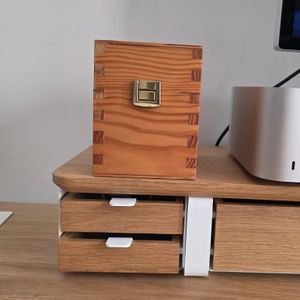
A Filofax? In this day and age? Surely not. Join me and I try to disentangle myself further from my phone. These posts will not come by e-mail, as they are image-heavy. Nobody needs these dropping into their hard drive.
Content Warning
This is for the stationery / productivity nerds. Normies risk being bored to tears. I have put links in - please note these are not affinity links, they’re just in case you want to check specifications etc.
Hardware
The bits and pieces that I'm using/experimenting with at the moment.
My Binder
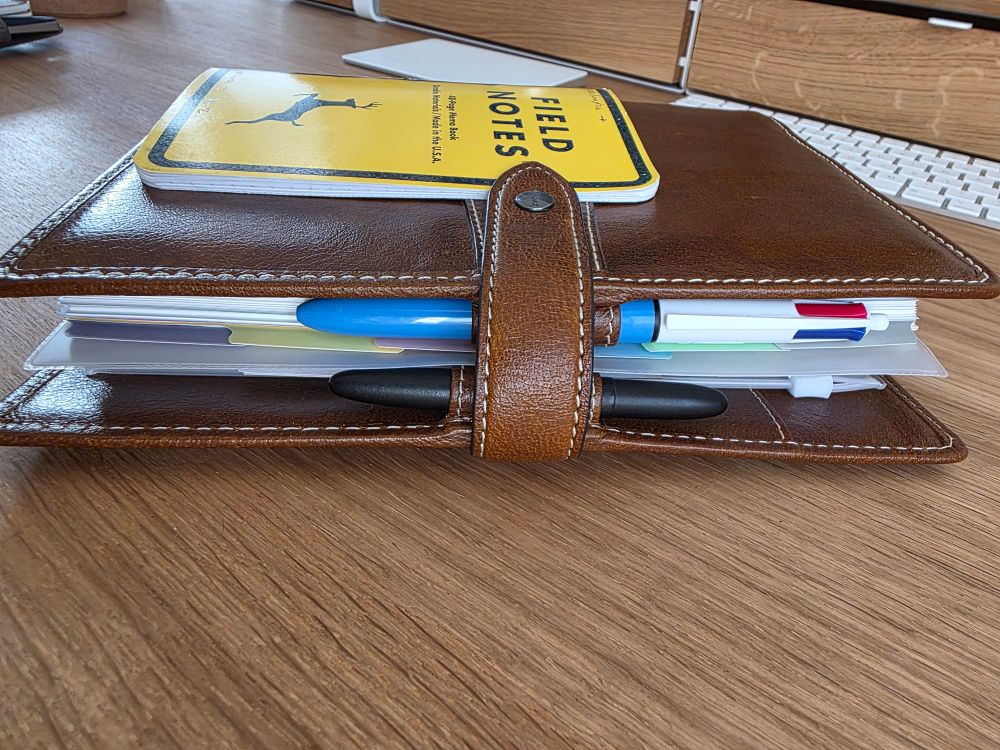
I have an ochre Filofax Malden in A5 made of antiqued leather. It lives on my desk, or in my briefcase if I’m carrying one. It’s too big to be my #edc: I use a pocket notebook as an extension of my system.
It was March when I decided to get some refills and see if I could move further from the digital and back to the analogue. I suspect this may be the worst month to make such a decision, as refills were harder to find than I expected. I ended up picking up a range from a variety of sources.
Setup
A joy of a ring binder system is its flexibility. The user customises the setup to suit their own workflow, and can change things up in a moment. Certainly, I have already made multiple changes as I get familiar with what’s working and what isn’t.
Pens
There are two loops in the Malden. For the moment, I carry a Bic Multipen, soon to be replaced by a swish Lamy version. In the other, a Fisher Space pen, which is what I carry with my pocket notebook when I don’t have the planner with me.
Cover and first section
I have some meeting notes inserts from Crossbow. Lovely paper that I can use a fountain pen with if I’m feeling fancy in front of a client. The pockets are mostly empty, but I daresay that will change. The front section has the “please return page”, some calendars and public holidays. Information pages, if you will.
Diary
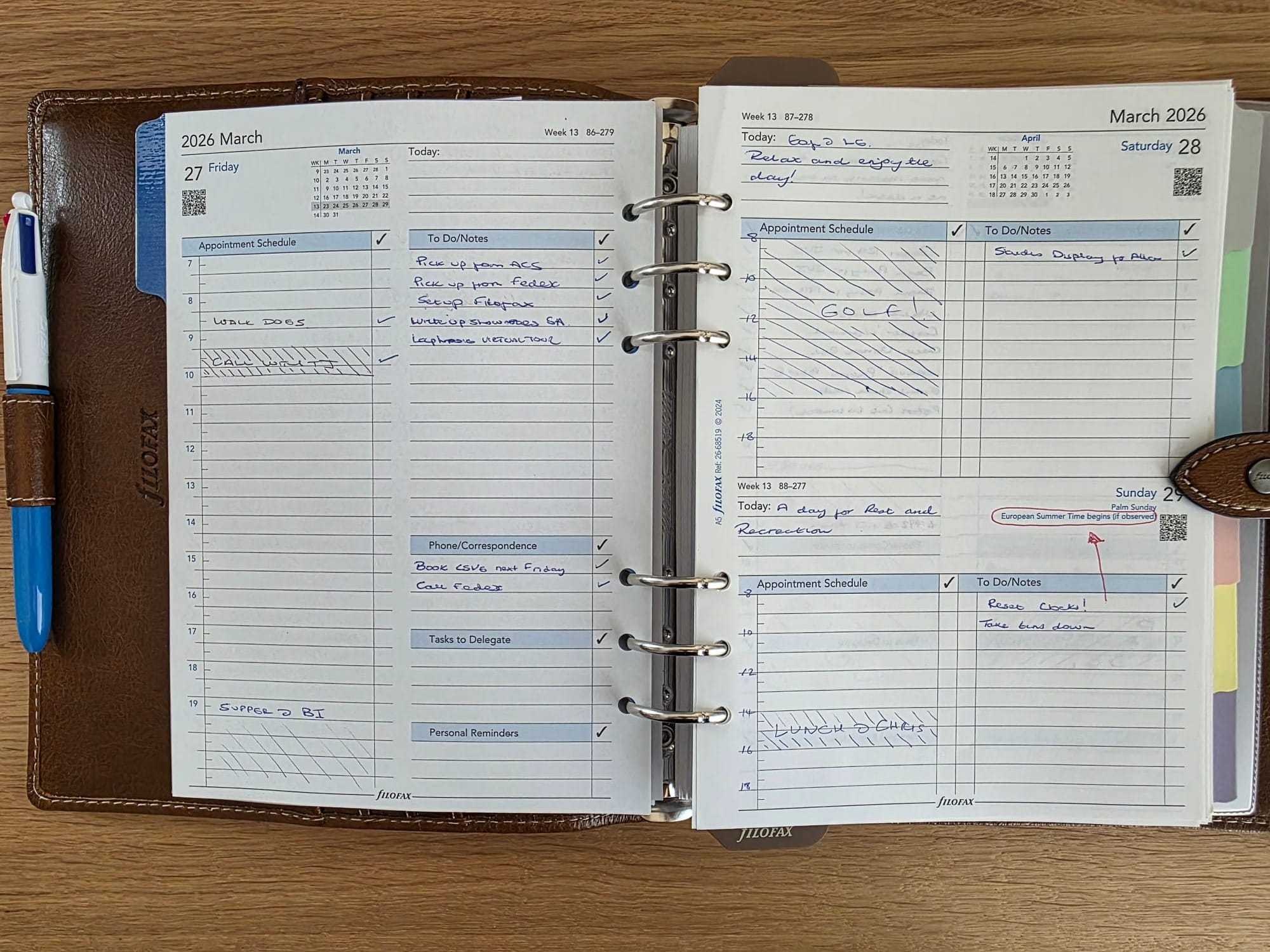
The divider is from Smythson, who used to have an organiser, but now limit themselves to some simple refills. Then I have a couple of month of diary pages. They were one day per page, and I have now switched to one day on two pages. (Both from Filofax.) I have been pleasantly surprised by the paper quality. Look, it’s not Tomoe or Rhodia, but it can handle ink. A double broad Meisterstuck? Maybe not, but a medium nib? Not too bad. I imagine that a Japanese fine would work very satisfactorily with both inserts, the two page per day marginally ahead. I wanted the two page per day because I use the Filofax as both a planner and a work journal. I use it to plan my days, manage my tasks and to record any decisions/agreements. Having defined sections pre-printed gives me a structural starting point.
Lists
The next section is a collection of lists behind some pastel dividers from Filofax. Books, TV & Movies, Web & Newsletters, Podcasts, Shiny New Objects, and Contacts. If I hear something in a podcast or read something in a book, I scrawl a quick note here.
Notes
Um, for notes. For stuff. My scratch pad.
Year Planner
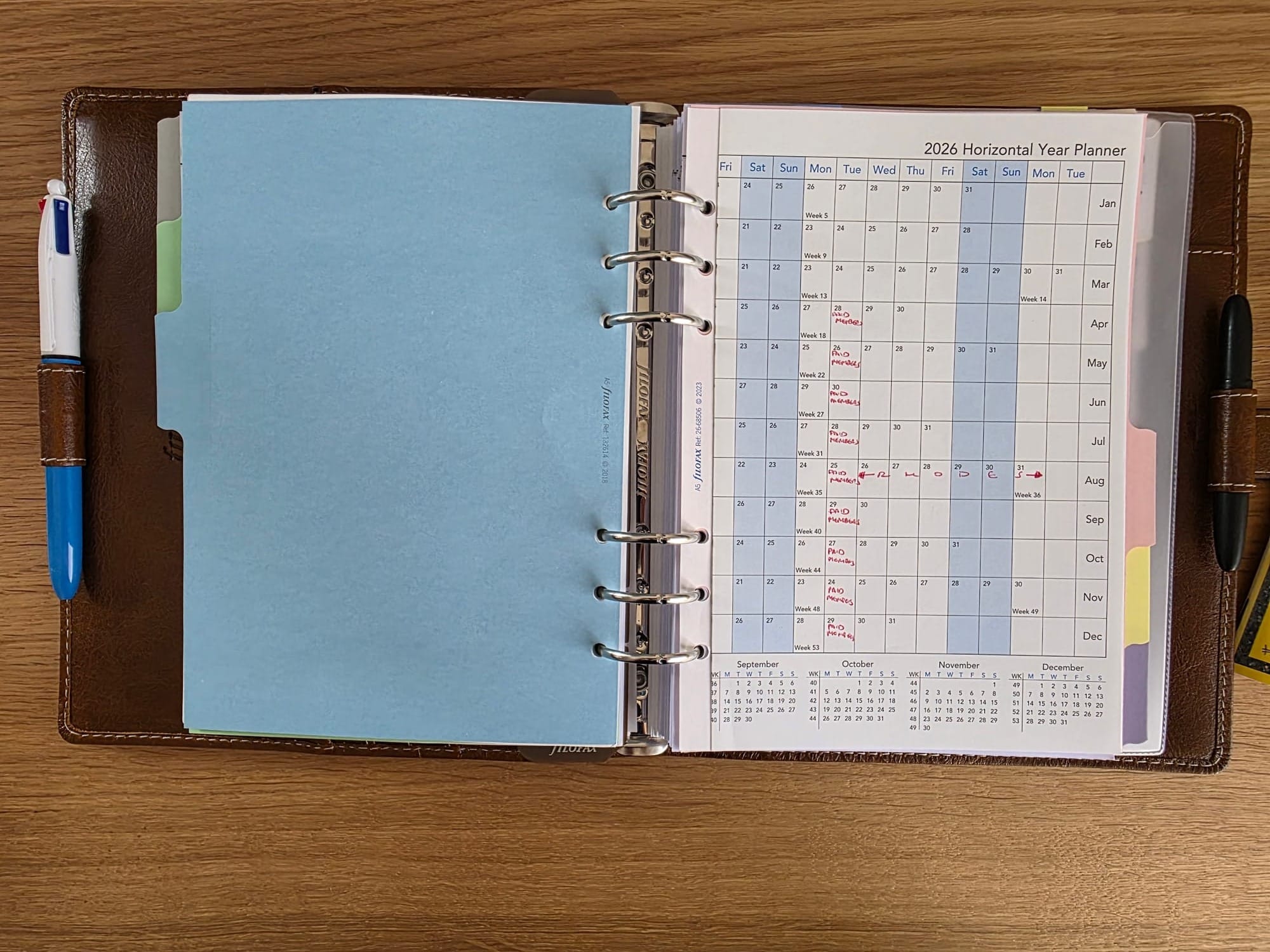
A horizontal fold-out planner. This is my content planner calendar.
Year Overview
A calendar for events. Trips, concerts, anything booked in advance.
At a glance
Plastic wallet
A plastic sheath for...something, I guess.
Goals
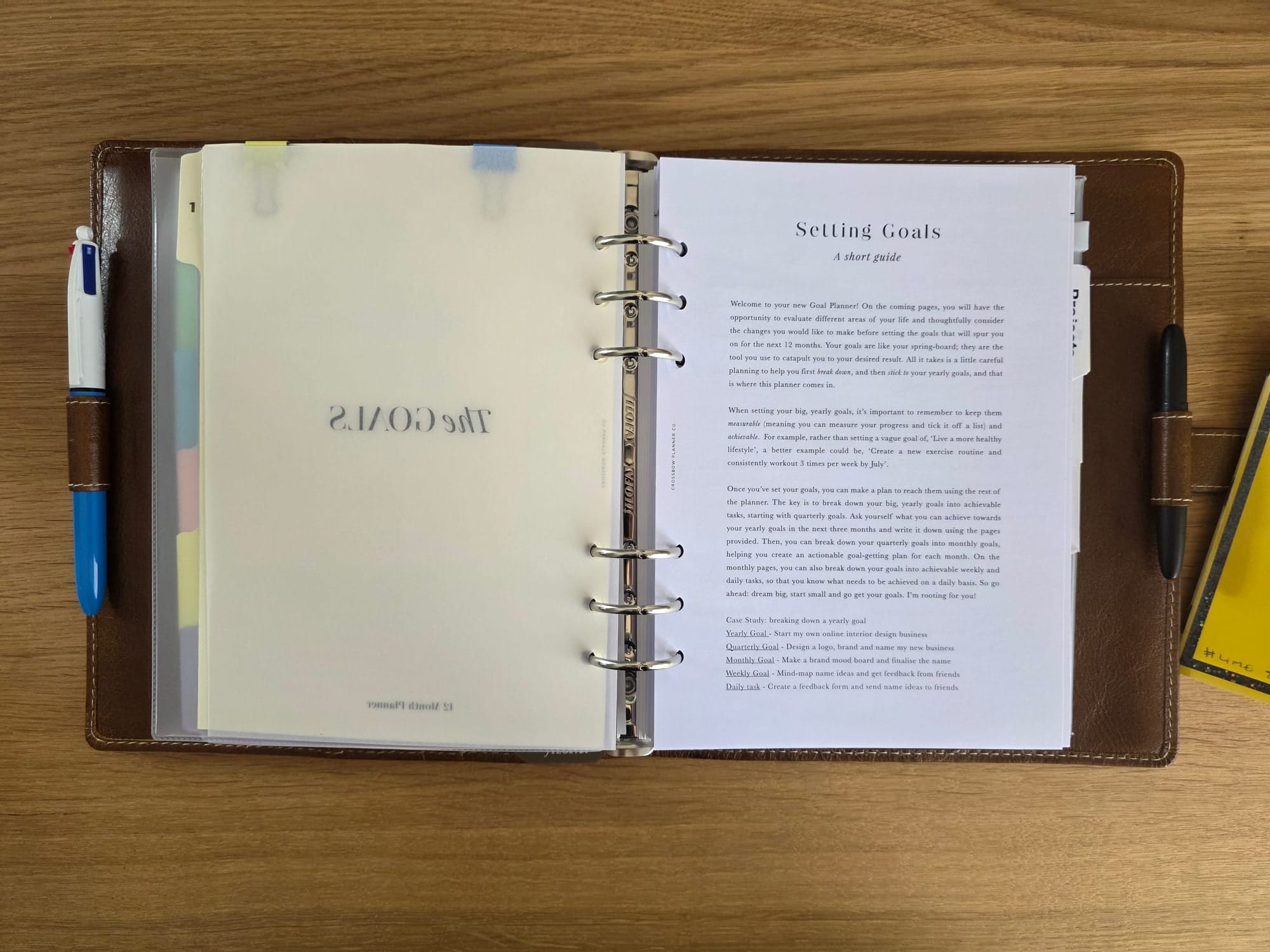
Behind another set of dividers, the first section is a goal setting kit from Crossbow. I love the idea of having these with me - rather than in a separate location or book.
Projects
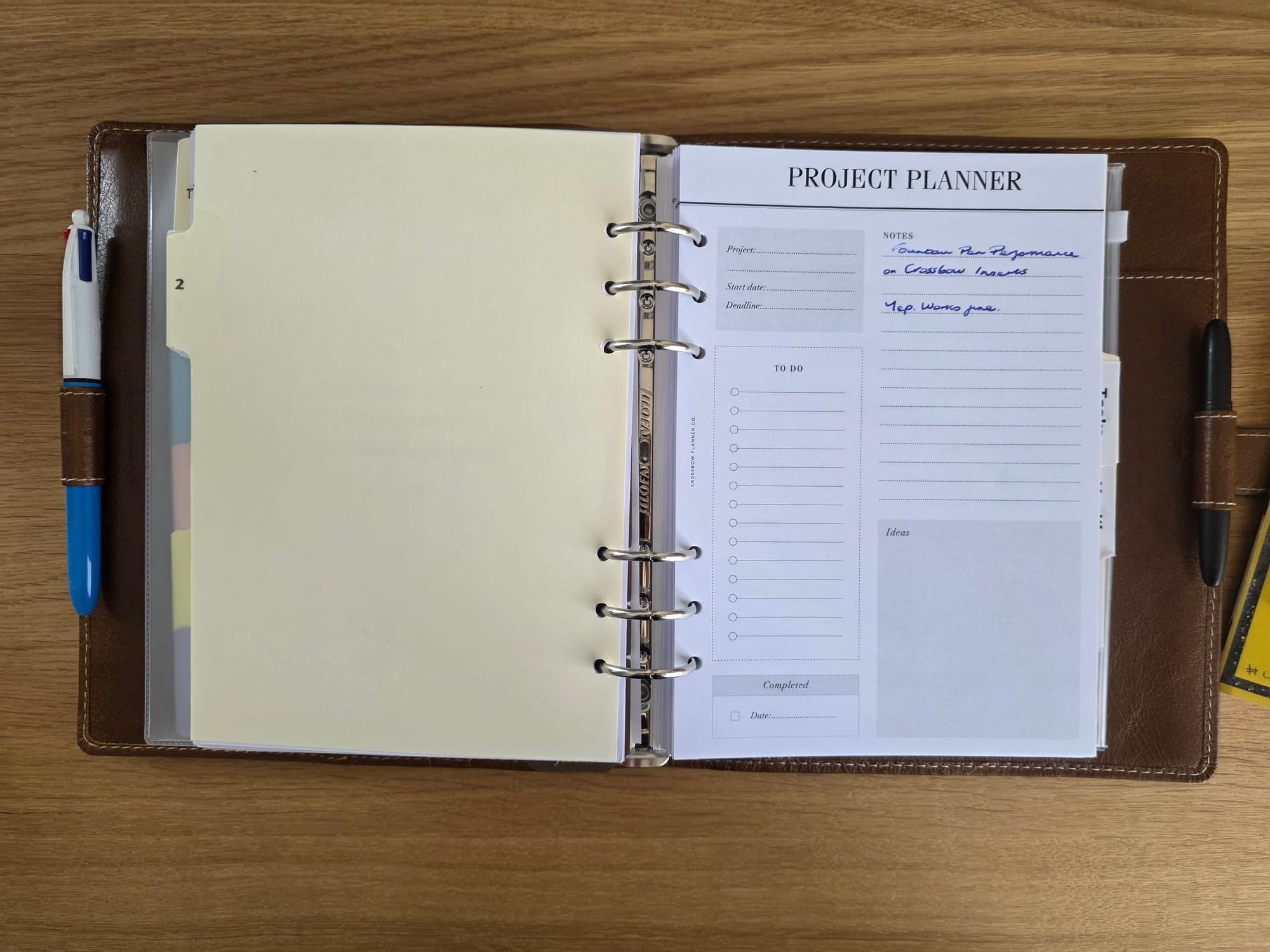
More from Crossbow. A place where I can give shape to an idea, and build a simple structure to move it forward.
Tasks
I have an insert for Recurring Tasks and then some List pages, should I want to catch a task somewhere undated.
Health
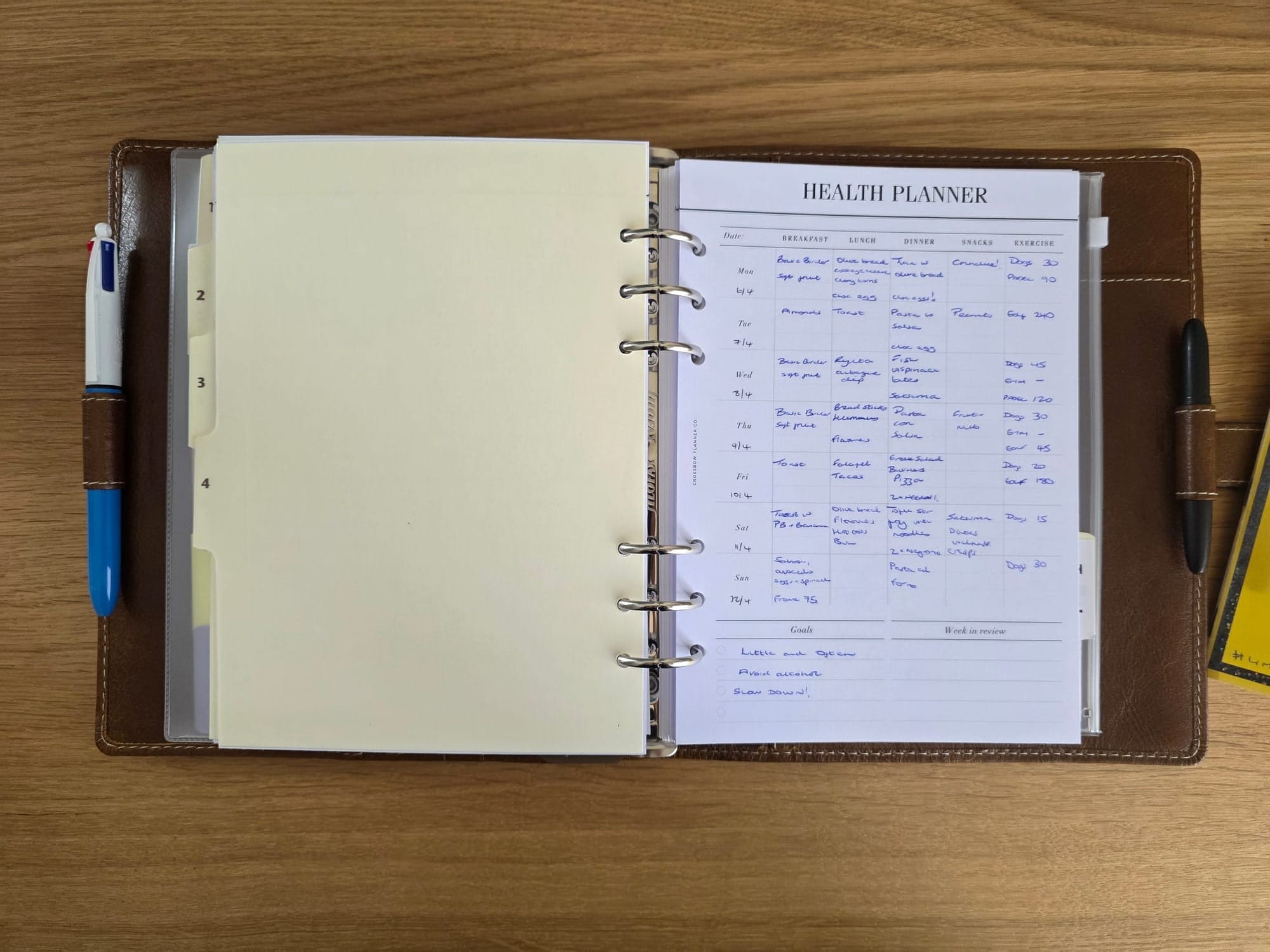
Food and exercise log. Some personal accountability. I’ve added some more list pages here, where I’ve transcribed some “standard” workouts for my gym visits (not that I take my Filofax to the gym...)
Travel
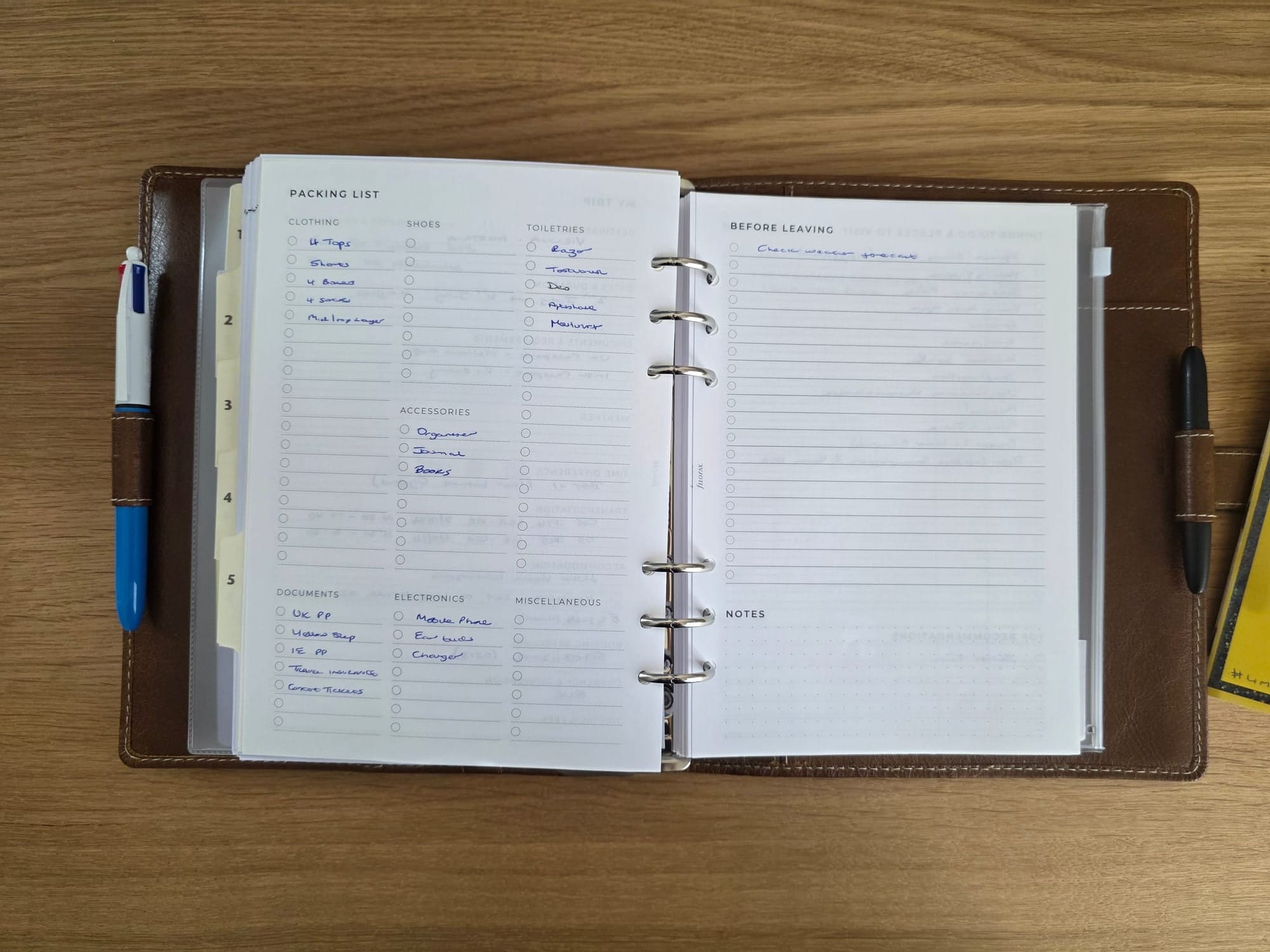
From Filofax, a series of pages for planning trips, including packing lists, checklists, things to do, bookings, budgets and expense trackers. Overkill? Maybe. But I’ll try them - and then adjust as necessary.
More Notes
Currently empty, but for a plastic ziplock wallet.
Usage
Still reading? Well done you, you are clearly stationery adjacent, to coin a phrase. The planner is my central repository for tasks and appointments. In Getting Things Done terms - this my trusted system, my source of truth. It has replaced Todoist. That’s less convenient, which is sort of the point. The system is not ubiquitous. It’s contained. If I don’t have my planner, then no amount of gazing at my phone or an internet browser will help. Can I meet you two weeks next Thursday? I don’t know. I’ll come back to you.
Risk
The system is not backed up. Lose the planner, lose the data. Could it happen? Yes, it could. I think I’d recover. Think of the shopping opportunity, for a start. Rebuilding a system from the ground up would be a pain, but luckily my life is not so complex that it requires multiple computers to log every task and appointment. I distinctly remember actually getting stuff done in the 1980s without any digital help.
Benefits
The containment of the system is its USP. I need to deliberately sit down with my planner regularly, to work out what the hell that I’m supposed to be doing. Certainly, I use it every working day and I probably check in at the weekends too. But once I close the planner, that’s it. It’s done.
Not being able to to say “Yes” to people all the time buys me time to say “No”. I go home, check the Filofax and check my motivation. Do I want to say “yes”? If I do, great. If not, I can diplomatically be otherwise engaged.
Calendars
I still maintain an electronic calendar - for the moment. This is a monster of my own creation, in that Mrs L takes comfort in knowing where I am, since I pushed very hard for shared calendars. So, If I’m going to be out playing padel or golf, it goes into the family calendar. Her default is to consider me available unless the calendar says otherwise. I will migrate this to me being unavailable, unless I’ve specifically agreed otherwise. I think this will happen naturally. Already, I take a point of checking in with Mrs L and her plans over breakfast. That’s all I need.
Multi-level planning
There are myriad ways of combining daily, weekly, monthly and quarterly pages to layout plans. I use a combination - and I’m not sure I have settled on a final system yet - but the ability to flick from my daily log to my yearly goals is useful. It helps me ensure a coherence between my vision and my actions.
Conclusion
Novelty is fun. Analogue is fun. Noodling is fun. Switching into an analogue task and time management system provides plenty of fun. Will it be consistent? Will it help my productivity? I think so, but then I would say that. I’ll undoubtedly keep you informed - whether you like it or not.
What do you do? What tricks am I missing? Let’s geek out on stationery. Drop me a mail.
People like you support my writing. Sign up for my free newsletter. Become a paid member, and get access to all my writing, including anything I publish, and a Member's Slack.